


By Cody Uhing, Director of Communications
On October 7 in Austin, Autonomy Summit 26 brought the autonomous vehicle ecosystem into one room: the developers building the technology, the companies powering it, and the advocates working to make sure it reaches the people who need it most. That range of voices is what gives AVIA its strength.
Here are the key takeaways.
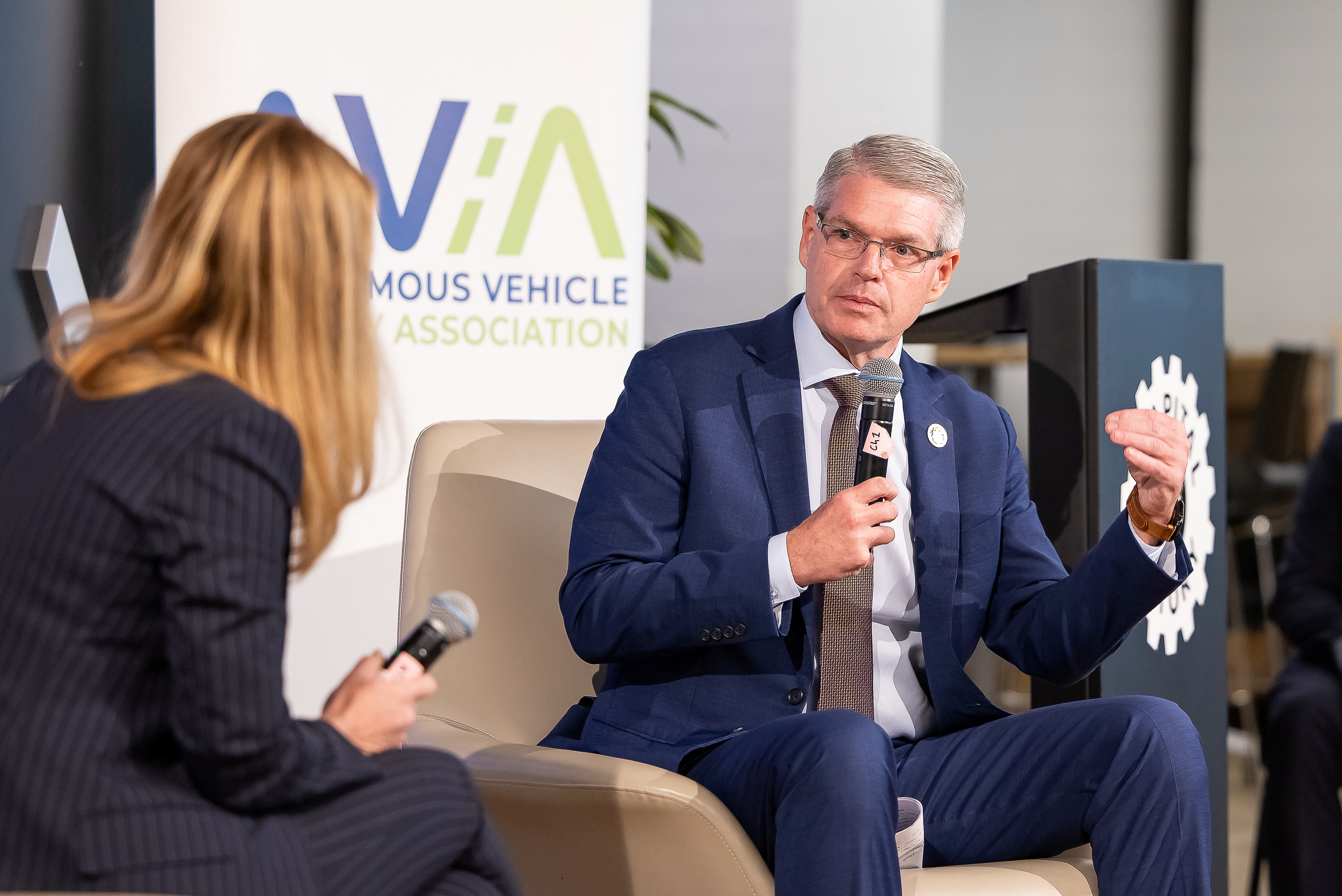
Following opening comments from AVIA CEO Jeff Farrah, Autonomy Summit 26 kicked off on a high note with a fireside chat between Aurora President Ossa Fisher and Federal Motor Carrier Safety Administration (FMCSA) Administrator Derek Barrs. During the conversation, Barrs announced that earlier that morning he had signed a five-year exemption allowing Level 4 autonomous trucks to use cab-mounted warning beacons in place of the reflective triangles federal rules require when a truck is stopped on the roadway.
The move by Barrs came after several years of significant advocacy from AVIA and its members. The authorization to use warning beacons instead of warning triangles was needed because autonomous trucks will not have an individual in the cab who can place warning triangles on the side of the road to warn oncoming motorists.
Fisher and Barrs also discussed the maturation of autonomous technology and the business, their respective career paths that led them to their current roles, and the need for federal regulations to evolve to secure American leadership on AVs.
We were also pleased to welcome Greg Zerzan, General Counsel at the U.S. Department of Transportation, to talk about AV regulations with Zoox General Counsel Chris Nalevanko. During the discussion, they covered the regulatory landscape and how the federal government is working to remove burdensome regulations.
That work has picked up under Transportation Secretary Sean Duffy. In April 2025, Duffy unveiled an Automated Vehicle Framework as part of the Department's Innovation Agenda. Zerzan shared an insider’s perspective on the administration’s goal of modernizing motor vehicle regulation and how that will unleash activity in the AV sector.

J.P. Morgan’s Brian Ossenbeck and Woven Capital’s Manas Punhani joined the event on a panel moderated by Capital Factory’s Nick Spiller. Ossenbeck and Punhani shared the investor perspective on AV technology.
Ossenbeck follows the autonomous trucking sector closely and provided insights from a recent report he issued on AV trucks, including tracking companies that have recently gone public as they hit technological and business milestones.
Punhani and his firm have been active investors in AV technology, and he brought the perspective of an early-stage private investor.
Both Punhani and Ossenbeck commented on how regulatory certainty gives investors confidence in the autonomous sector.
In addition to federal policymakers, we welcomed Texas officials to discuss AV regulations that have made the state a destination for technology developers. Texas is home to AV ride-hailing deployments and autonomous trucks are hauling freight along key corridors.
During a conversation with Kodiak’s Blake Calvert, Toby Baker, Deputy Chief of Staff to Governor Greg Abbott, talked about the benefits of autonomous vehicles to both safety and accessibility. He emphasized the governor’s work to encourage businesses to build and grow in the state and how autonomous vehicles are part of a fabric of innovative companies that has diversified the state’s economy in recent years.
Waabi’s Katie Carmichael spoke with Darran Anderson, Senior Director of Strategy and Innovation at the Texas Department of Transportation, and Clint Thompson, Director of the Motor Carrier Division at the Texas Department of Motor Vehicles, about implementation of the state’s recent AV legislation and what the data has shown about AV safety as more vehicles deploy.
We also heard from David Liu, co-founder and CEO of PlusAI, a leading autonomous trucking company. Liu was joined on stage by Dan Van Alstine, former President of Ruan Transportation Management Systems. Liu shared insights from PlusAI’s journey as a company, including its recent public offering, and he emphasized the need for sound public policy to support the deployment of autonomous vehicles in the U.S.
Liu also made clear that safety matters as much as the business case. “There will be a day when there are no accidents, and that is what we are working toward,” he said. “Even one road death is too many.”
GM’s Shelly Chaka, Executive Director of Safety Assurance for Effective Autonomous Driving Software, focused her presentation on public trust. GM plans to launch its first automated driving system on the Cadillac Escalade IQ in 2028. Because customers will decide whether to turn it on, Chaka said they need to believe it drives at least as safely as they do.
That starts with how safety is proven. Traditional automotive testing ties every requirement to a specific test, which works for seatbelts and automatic emergency braking but not for an AI driver facing endless, unpredictable situations. GM instead builds a safety case, an evidence-backed argument that the system is ready, and validates it continuously through simulation and on-road testing.
Chaka closed by noting that trust is built in public, pointing to GM’s published safety report, its first responder advisory council, and its work with industry and government on data sharing and performance standards.
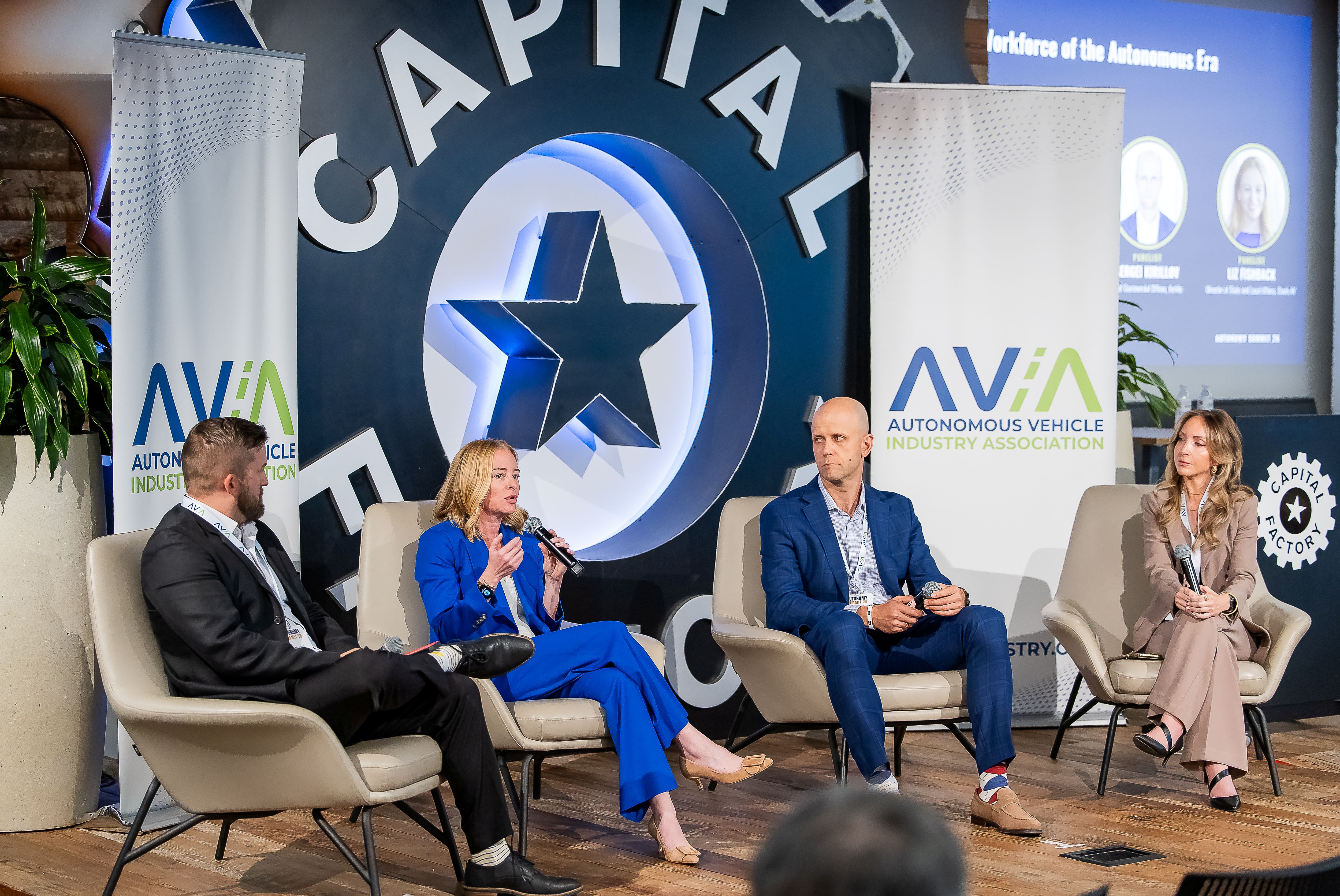
We closed the day with a conversation moderated by Nick Allen from TaskUs about the workforce needed for autonomous vehicle deployment. Liz Fishback (Stack AV), Morgan El-Zeinab (NGV Talent), and Sergei Kirillov (Avride) discussed the jobs and investment AV deployment is bringing.
As the industry grows, the career opportunities grow. From vehicle assembly to maintenance and management, AV companies hire workers with diverse skills and experiences. Engineers design the hardware and software that make safe operation possible. Technicians maintain and repair sensors and onboard computers. Operations teams inspect, fuel, clean, and monitor the fleet. As Fishback noted, 70 percent of AV industry job openings don’t require a college degree.
The economic impact is already measurable. Autonomous trucking currently supports 17,000 jobs and $3.3 billion in total economic output, according to Steer.
These are good jobs that typically pay above the U.S. median wage, and AVs may create more high-skilled and specialized jobs in the industry over time.
The benefits extend beyond AV companies themselves. AVs have the potential to catalyze economic growth in adjacent industries, and the U.S. has the potential to establish itself as a major exporter of AVs.
Autonomy Summit 26 made one thing clear: when the government sets clear rules of the road, this industry delivers. We saw it in FMCSA’s beacon exemption, in USDOT’s work to modernize outdated standards, and in Texas, where a thoughtful framework has made the state a hub for deployment.
Now Congress needs to finish the job. Only a national framework can give companies the certainty to build and scale here at home, and the SELF DRIVE Act, built around the same kind of safety case GM described, would provide it. AVIA will keep making that case until it becomes law.
Thank you to our speakers, members, and partners for making this year’s Summit a success. There is a lot of work ahead, and I have never been more confident in where it leads.


Keep up to date with the latest news from the Autonomous Vehicle Industry Association (AVIA).