

By Jeff Farrah, CEO of the Autonomous Vehicle Industry Association
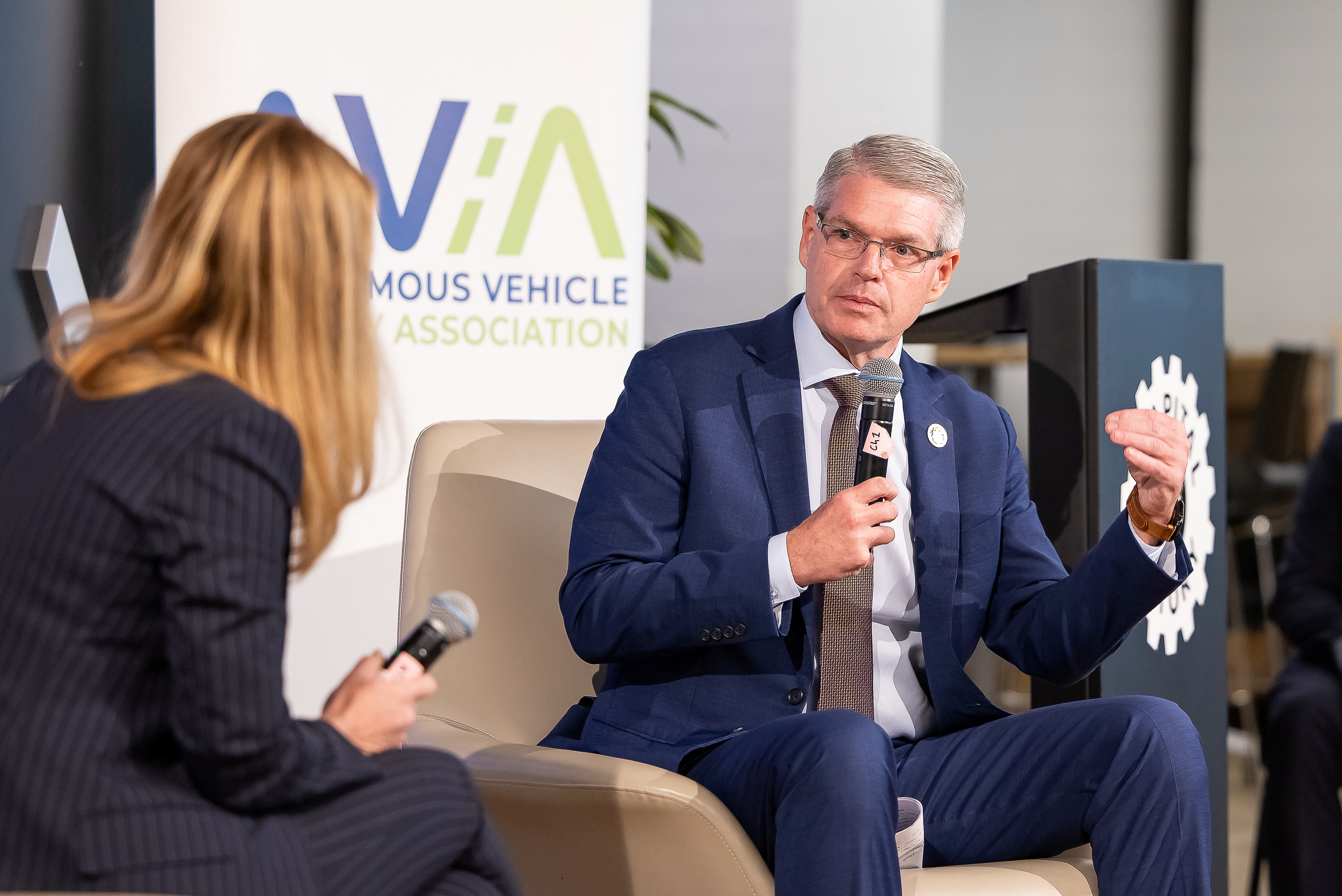
Earlier this month, Federal Motor Carrier Safety Administration (FMCSA) Administrator Derek Barrs took the stage at AVIA's Autonomy Summit 26 in Austin, Texas, and announced that his agency approved the use of cab-mounted warning beacons in place of traditional warning triangles for autonomous trucks. The announcement was met with tremendous excitement and gratitude from AVIA and its members joining Barrs at the conference.
FMCSA’s decision was needed to unleash the true potential of the autonomous trucking sector. Federal rules require reflective triangles to be placed behind a stopped commercial truck within ten minutes. Because autonomous trucks will not have a human driver in them, a new approach is needed. Cab-mounted beacons solve the problem by warning approaching traffic directly from the vehicle. Under the exemption, the beacons must activate within five minutes, half the time currently allowed for triangles, and stay on for the entire stop. The agency action permits use of the beacons for a five-year period, replacing its previous temporary waiver.
Warning beacons drew support from a diverse set of organizations, including the autonomous vehicle industry, trucking associations, carriers, technology companies, manufacturers, business groups, university researchers, and law enforcement.

Few regulatory decisions draw support from such a wide spectrum, and each of the constituencies brought its own reasons for evolving the federal requirement to place warning triangles behind a disabled truck.
Under a limited FMCSA waiver from October 10, 2025 through January 9, 2026, Aurora operated 34 autonomous trucks equipped with beacons for more than 500,000 miles, with the beacons active for nearly 10 hours in total. The trucks were not involved in any collisions while stopped with the beacons in use, and Aurora reported no beacon faults, malfunctions, or power issues. FMCSA found no data indicating the waiver had any negative effect on safety.
In a study Aurora conducted, approaching motorists began slowing or changing lanes farther back from the truck in six of eight scenarios when beacons were used instead of triangles. Research by the Virginia Tech Transportation Institute found that beacons prompted earlier braking and slower passing speeds at night. In the same study, 78 percent of daytime participants and 83 percent of nighttime participants said beacons were more noticeable and easier to see than triangles.
FMCSA paired the exemption with strong conditions and oversight. The beacons must be amber, meet SAE International J595 Class 1 photometric standards, sit at least 100 inches off the ground, and run on redundant power so a single failure cannot shut them off. Trucks may use the exemption only within their operational design domain (ODD) and may not carry passengers or hazardous materials. Carriers must notify FMCSA before operating under the exemption, report any crash within five days, and file annual reports on any beacon malfunctions. With those safeguards in place, FMCSA concluded the beacons will likely achieve a level of safety equivalent to or greater than the current rules.
Under the recent FMCSA action, cab-mounted warning beacons may only be used by autonomous trucks. But the advancement holds great promise for human truck drivers who must currently walk along live highway shoulders to set out warning triangles. Amazon urged FMCSA to extend the beacons to human-operated trucks to improve driver safety during roadside emergencies, and FMCSA agreed that the beacons offer a practical safety benefit for traditional trucking. The agency wrote that updating warning device requirements for all commercial vehicles "may be ripe for future regulatory action."
FMCSA’s decision on beacons will unlock significant market confidence in autonomous trucks. There is a strong connection between regulatory action and investment in autonomous vehicles. For example, AVIA has previously shared that in 2018 the Department of Transportation issued a seminal policy guidance document that stated the agency regulations “will no longer assume the [commercial motor vehicle] driver is always a human or that a human is necessarily present onboard a commercial vehicle during its operation.” Following this move, well north of $6 billion in private capital has been invested into autonomous trucking companies, with even more in the public markets. I believe that FMCSA’s decision on cab-mounted warning beacons will similarly provide a boost to the sector as a federal policy framework is developed.
Trucking groups, law enforcement, researchers, technology companies, and autonomous vehicle developers reached the same conclusion FMCSA did: cab-mounted beacons make stopped autonomous trucks safer for everyone on the road. The decision is a model for how federal regulators can weigh real-world data, set clear safety conditions, and clear the way for autonomous trucks to deploy.


Keep up to date with the latest news from the Autonomous Vehicle Industry Association (AVIA).