
.svg)
By Cody Uhing, Director of Communications, Autonomous Vehicle Industry Association
Academics and experts around the world are studying how autonomous vehicles can improve safety, enhance mobility, and create new economic opportunities, among other transformative benefits. AVIA’s Research & Discoveries (R&D) Series highlights these reports’ findings about how AVs can create a safer and more mobile world.
Key takeaways:
• Autonomous trucks could save up to 490 lives and prevent 8,800 injuries on U.S. highways every year.
• A more efficient freight sector means lower prices for American households — an estimated $9 billion in additional purchasing power annually.
• The industry already supports 17,000 jobs and is creating a new generation of skilled work that does not require a college degree.
A new report from Steer Group, in partnership by Aurora Innovation, offers one of the most comprehensive assessments to date of what self-driving freight could mean for America’s economy, workforce, and roads. The study, Economic Impacts of Self-Driving Freight in the U.S., models the effects of Level 4 autonomous trucking on medium- and long-haul freight routes through 2035, examining three adoption scenarios: Conservative, Moderate, and Accelerated.
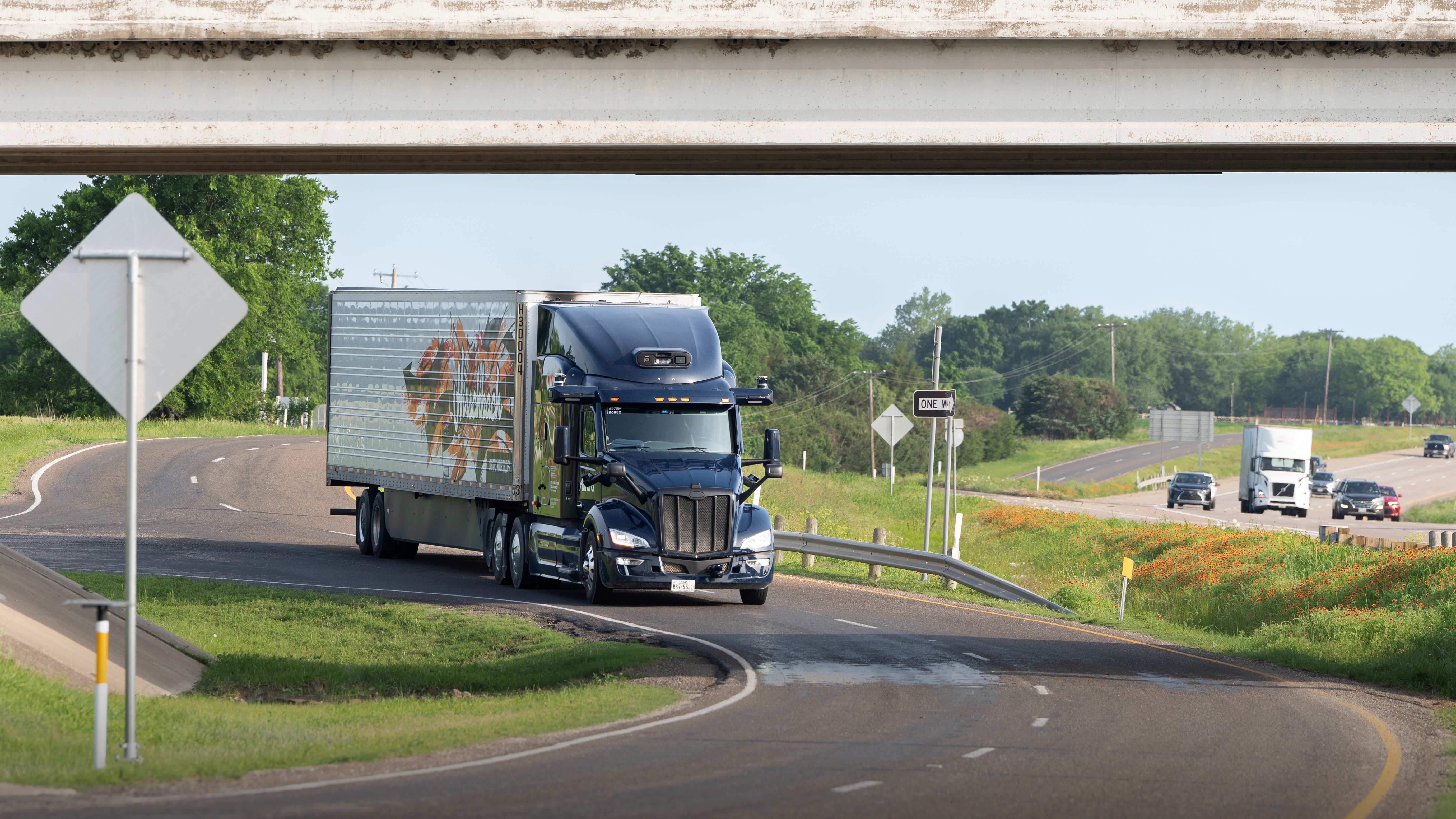
Self-driving freight technology is not a distant proposition. AVIA members, including Aurora, Gatik, Kodiak, Plus AI, Torc, Stack AV, Volvo Autonomous Solutions, and Waabi are already operating or piloting autonomous trucks on U.S. highways. The Steer analysis finds that even under a moderate adoption scenario, the technology could cover 8 percent of U.S. truck freight by 2035. Under an accelerated scenario, that figure reaches 15 percent, representing 170,000 self-driving trucks traveling 33 billion miles annually.
Roadway Safety
Every year, 5,300 people are killed in crashes involving large trucks in the United States, according to the National Highway Traffic Safety Administration. Large trucks account for 1 in 8 fatal crashes on U.S. roads, despite making up a small share of total vehicles. The Federal Motor Carrier Safety Administration has found that when a truck is the critical reason for a crash, 87 percent of the time the cause is driver error: inattention, poor decision-making, fatigue, or impairment.
Automated driving systems address the root causes of these accidents directly. They maintain attention 100 percent of the time, react to hazards faster than a human driver, and can detect obstacles at distances a person behind the wheel cannot.
The available safety evidence from deployed autonomous vehicles is encouraging. Across nearly 125 million fully autonomous miles operated in San Francisco, Los Angeles, Phoenix, and Austin, Waymo has achieved a 90 percent reduction in serious and fatal crashes compared to an average human driver, and an 81 percent reduction in injury crashes. While robotaxis operate in urban environments distinct from interstate freight corridors, this track record provides a meaningful baseline for what the technology can do.
Steer’s modeling applies a conservative reduction rate to freight-specific conditions. Under the accelerated scenario by 2035, self-driving trucks could avoid 490 fatalities, 8,800 injuries, and 23,000 damage-only crashes annually. Measured against U.S. Department of Transportation cost-benefit guidance, those safety gains represent $9.4 billion in economic value per year. Fuel efficiency improvements from smoother autonomous driving would additionally reduce NOx emissions by 10,000 short tons and particulate matter (PM2.5) by 600 tons per year, producing $730 million in annual public health benefits.
Trucks move more than 60 percent of domestic freight tonnage in the United States and contribute more than $600 billion annually to GDP. It is, in the most literal sense, how the country keeps its shelves stocked. When freight is slow or expensive, those costs eventually appear in the price of groceries, building materials, and consumer goods.
Autonomous technology addresses the friction points that make trucking expensive. Federal hours-of-service rules require drivers to take mandatory rest breaks and limit maximum driving time to 11 hours within a 14-hour window. A driver-operated truck making a roughly 1,000-mile run from Fort Worth to Phoenix can cover only about 750 miles before requiring an overnight stop. An autonomous truck making the same trip can drive for more than 18 hours, completing the full run and starting the return journey within a single day. Fleet utilization, the Steer report finds, can more than double.
Beyond utilization, self-driving systems improve fuel efficiency through optimized acceleration, deceleration, and speed management. Steer estimates a 13 to 32 percent net energy efficiency improvement under its scenarios, translating to 1.6 billion gallons of fuel saved and $5.7 billion in carrier fuel savings annually under the Accelerated scenario. Improved safety records are also projected to reduce insurance costs by 40 percent, saving carriers $1.4 billion per year.
Combined, these operating cost reductions of 15 to 25 percent per mile pass through to consumers. Under the accelerated deployment scenario, Steer projects $9 billion in additional purchasing power for U.S. households by 2035, as lower shipping costs flow into the price of everyday goods. The macroeconomic ripple effect is also material: by enabling greater productivity, specialization, and trade, lower freight costs are projected to generate $6 billion in net additional U.S. GDP annually.
Autonomous freight sometimes prompts concerns about job displacement. The Steer report addresses this directly, and the picture is more nuanced than critics suggest.
Of the 33 billion self-driving truck miles projected for 2035, 25 billion reflect growth in freight demand, and not substitution of existing drivers. The report concludes that normal occupational turnover, which runs at roughly 3 percent per year in trucking, can absorb the transition without layoffs. This matters because the industry faces a genuine recruitment challenge: trucking companies will need to hire 1.2 million new drivers over the next decade just to keep pace with demand and retirements, and the average professional truck driver is already over 48 years old.
Self-driving freight does not remove trucking jobs. New roles are emerging in engineering, advanced manufacturing, remote operations and monitoring, and maintenance and repair of autonomous systems. According to research by Chamber of Progress cited in the Steer report, 82 percent of AV workers are expected to earn above the median U.S. wage, and many of these positions are accessible to workers without a college degree.
The industry already demonstrates this employment model. Today, AV trucking companies support $3.3 billion in total economic output and 17,000 jobs across the United States, with operations concentrated in California, Texas, and Pennsylvania but generating multiplier effects well beyond those states.
The Steer report is notable not only for the scale of benefits it projects but for the clarity of its policy message: these gains require a supportive regulatory environment to materialize. State-by-state variation in autonomous vehicle rules creates uncertainty for carriers and limits the nationwide economic benefits the technology can deliver. Steer explicitly notes that states providing clear authorization for autonomous freight operations are already attracting commercial deployments and the economic activity that comes with them.
This is precisely why AVIA has strongly advocated for a federal policy framework on AVs. Only the federal government can establish uniform vehicle design and performance standards that apply across state lines. The SELF DRIVE Act, sponsored by Rep. Bob Latta, and the AMERICA DRIVES Act, sponsored by Rep. Vince Fong, would help provide that framework and enable companies to scale operations nationally and give American industry the certainty it needs to compete. The data from Steer’s analysis makes clear what is at stake: hundreds of lives, billions in consumer savings, and a stronger supply chain for the American economy.
Read the full report here.


Keep up to date with the latest news from the Autonomous Vehicle Industry Association (AVIA).